Before the scooter, a word about the price list. In the Kaabo USA menu, the whole Mantis range appears at once:
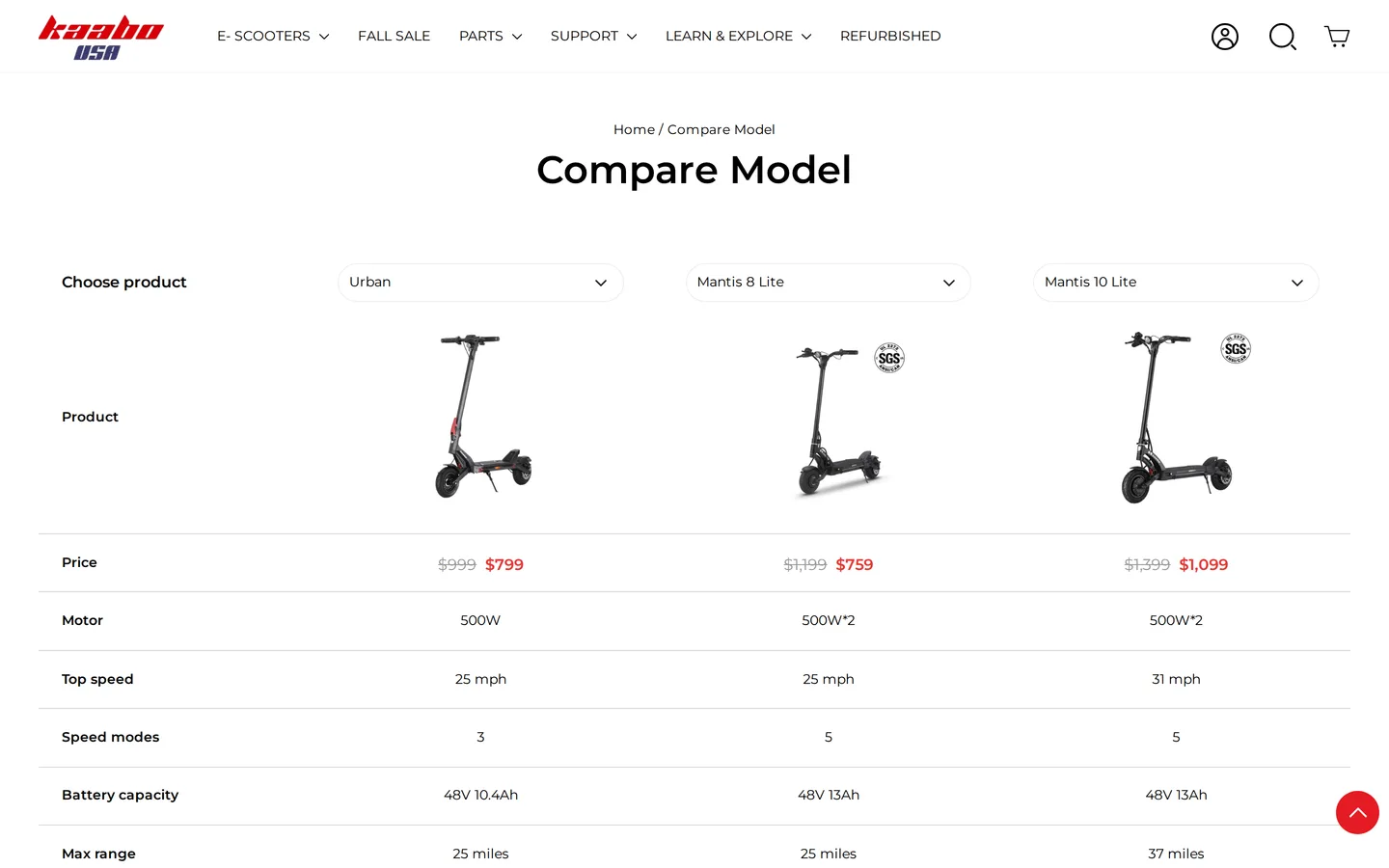
Urban: $799 (list $999)
Mantis 8 Lite: $759 (list $1,199)
Mantis 10 Lite: $1,099 (list $1,399)
Mantis X Plus: $1,299 (list $1,699)
Mantis King Pro: $1,599
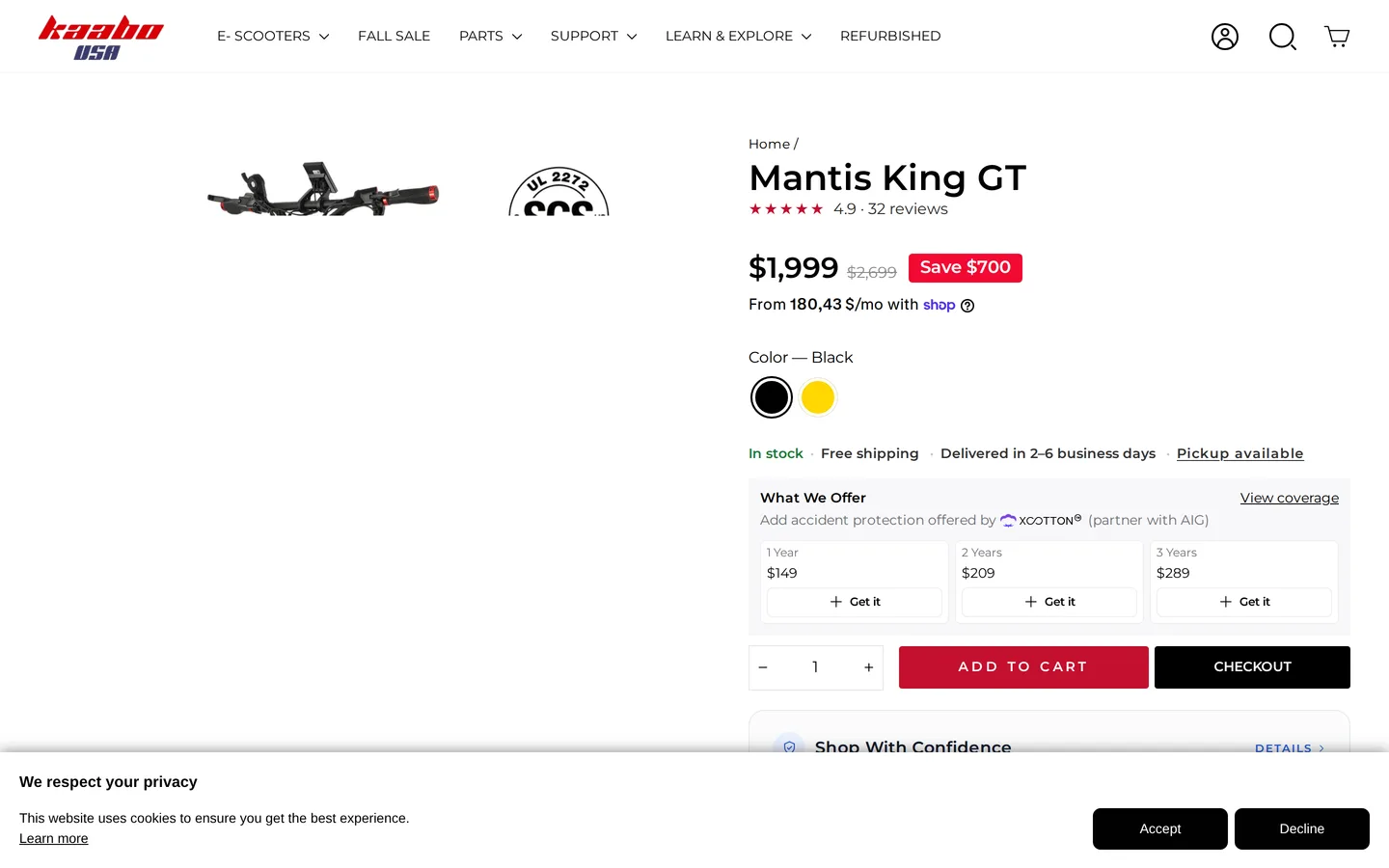
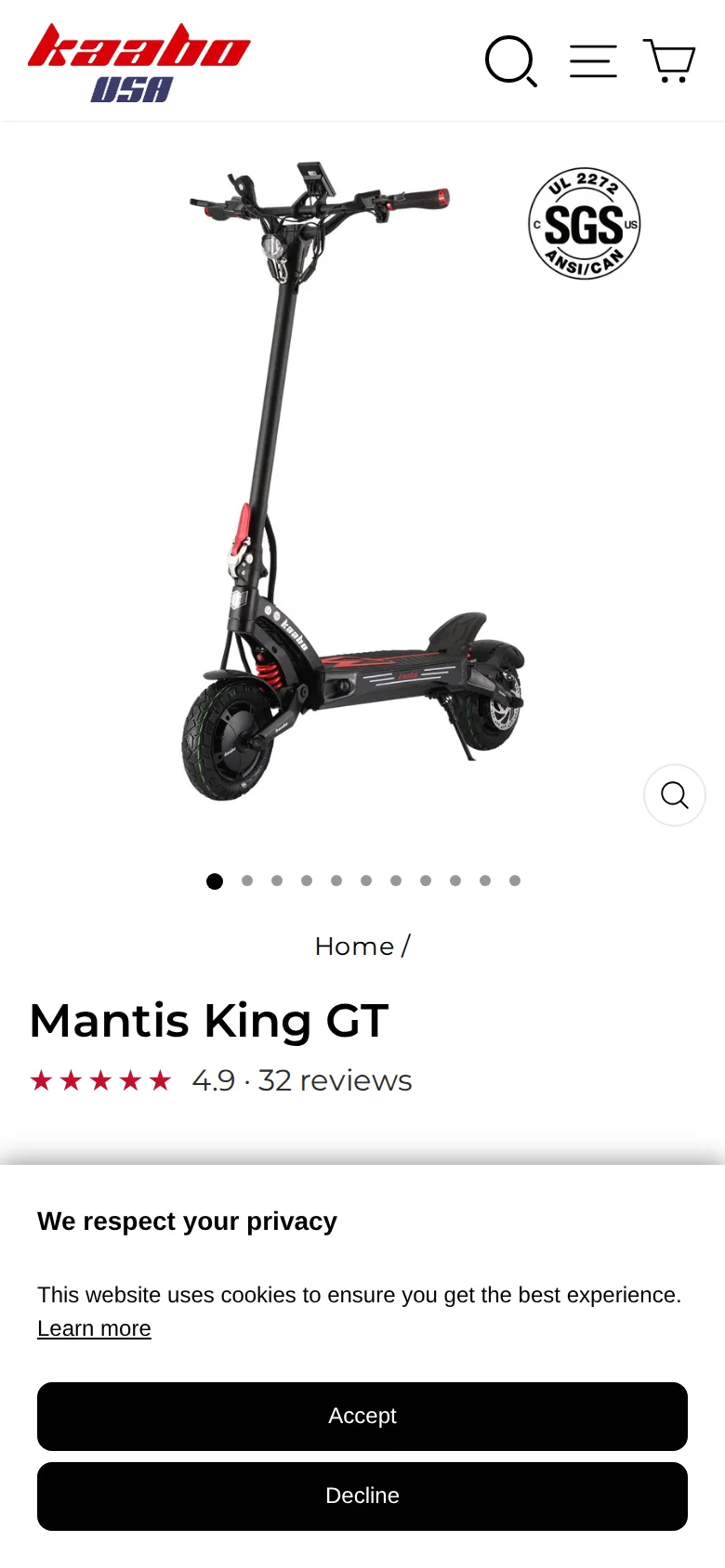
Mantis King GT: $1,999 (list $2,699)
Every model is discounted, and the discount runs from $200 to $700. When a brand discounts its entire catalogue at once, the list price stops meaning anything — the real price is the selling price.
Never judge a scooter by the size of the discount. Compare it against machines at the same actual selling price, not the same list price.
At $1,999 the King GT competes directly with the Apollo Phantom 2.0 ($2,199), not with the Dualtron Thunder 3 ($3,299).
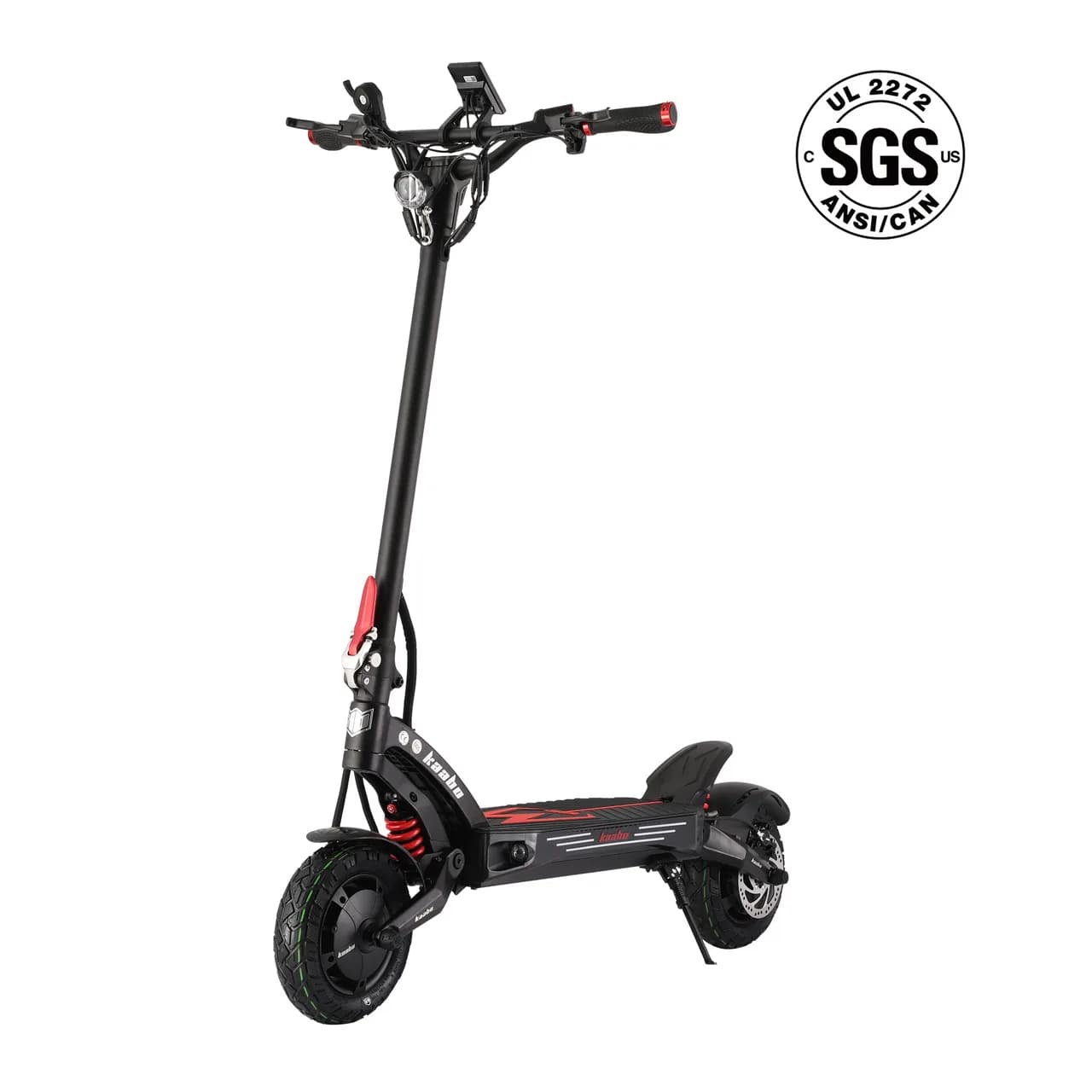
Two 1100 W motors
The 1100 W × 2 configuration puts the King GT in the middle of the performance group: far stronger than single-motor 500 W machines, but below the 2000 W × 2 models such as Kaabo's own King GTR Max.
Many riders consider this the sweet spot. Enough to climb steep gradients and accelerate hard, but not so much that you dare not open it fully. A 2000 W × 2 machine doing 105 km/h is for people with real experience only.
Two-wheel drive brings practical advantages beyond speed too: traction is split, so there is less wheelspin on wet surfaces and better grip on gravel.
Why the Mantis line is trusted
In the electric scooter community, Mantis is the name that comes up most often in discussions of performance-to-reliability ratio. Most of the reason sits in the frame and the folding mechanism — the two places performance scooters usually fail.
A powerful scooter puts a great deal of force through the folding joint at the stem. When that joint develops play, the bars wobble, and a wobble at 60 km/h is a serious matter. The Mantis has a reputation for that joint staying tight.
Which Mantis to choose
Since Kaabo lays the whole range out in one menu, here is how to read that table quickly.
Urban, $799: a single 500 W motor. A commuting scooter, not a Mantis in the performance sense.
Mantis 8 Lite, $759: two 500 W motors, 8-inch wheels. The lightest of the twin-motor versions, suited to dense city riding.
Mantis 10 Lite, $1,099: two 500 W motors, 10-inch wheels. Bigger wheels mean a smoother and safer ride at speed.
Mantis X Plus, $1,299: the best-selling version of the line, balancing price against performance.
Mantis King GT, $1,999: two 1100 W motors. A real step up in power over everything below it.
If you are torn, settle the wheel size before the power. 8-inch and 10-inch wheels are completely different experiences on broken city tarmac, and no amount of power compensates for wheels that are too small.
Spares sold openly: the biggest plus point
Kaabo sells directly from its own site: 10-inch tyres at $55, inner tubes at $10, 11-inch puncture-resistant tyres at $79, plus displays, controllers, motors, brakes and lights.
On a performance machine, this matters more than most specifications. Fast scooters wear tyres and pads far quicker than commuting scooters. Knowing a replacement tyre costs $55 and is in stock is the difference between a machine that lasts and one that gets abandoned when it breaks.
Very few brands do this. It also suggests Kaabo accepts owners working on their own machines — the right attitude for a product like this.
For buyers outside Kaabo's markets
Kaabo USA serves the US market. The 18-month warranty and 30-day returns do not travel with a grey import.
But because spares are sold openly, keeping a Kaabo running outside those markets is more feasible than keeping a scooter from a brand that sells complete machines only. Tyres and brake pads are what you need most often, and both can be ordered.
We score it 8.0 — at the $1,999 selling price. At the $2,699 list price the score would be a good deal lower.
Nhìn tận mắt