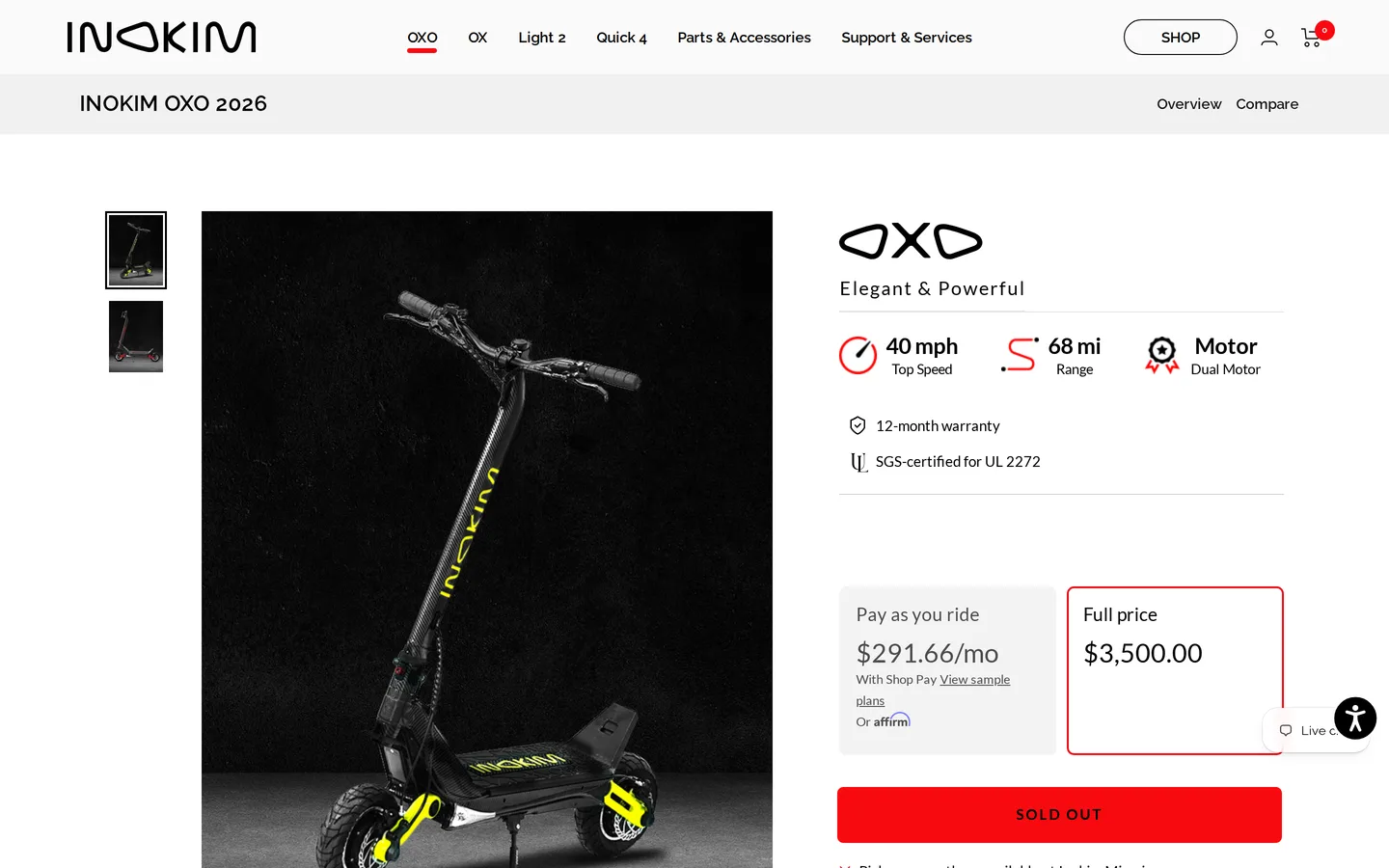
In the headline block on the OXO page, Inokim lists four lines: speed, range, motor configuration, and a 12-month warranty. Directly beneath is a fifth:
SGS-certified for UL 2272.
We have read the product page of almost every performance scooter in this series. This is the only one that states battery safety certification at the top of the page.
SGS and UL 2272: why they matter more in this class
UL 2272 is the safety standard for the electrical systems of personal electric vehicles. SGS is one of the largest independent testing bodies in the world — meaning this certification was issued by a third party, not claimed by the maker.
Why it matters particularly on a performance scooter: these machines carry very large packs and draw very high current. A 500 W scooter draws modest current; a twin-motor machine draws many times that, and any flaw in the pack's thermal design shows up under that load.
Put differently: the class that most needs certification is the class that publishes it least. The $449 Gotrax G4 states UL 2272. The $3,299 Dualtron Thunder 3 does not.
The more power, the more the battery-safety question deserves asking. A $3,000 scooter is not automatically safer than a $450 one — it is just dearer.
64 km/h: a sensible choice
A top speed of 40 mph, about 64 km/h. Against the Dualtron Thunder 3 at 101 km/h and the Apollo Phantom 2.0 at 71 km/h, the OXO is the slowest of the performance group.
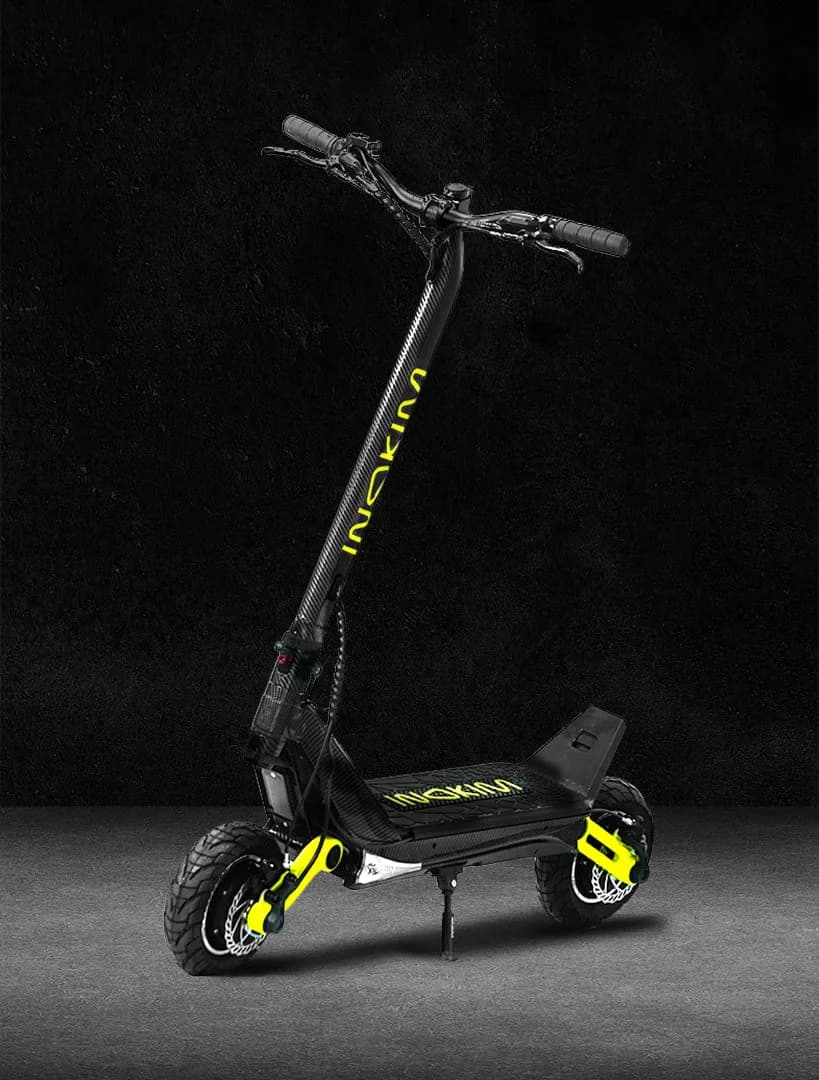
We read that as the right call. 64 km/h keeps pace with urban traffic — fast enough not to be squeezed to the kerb, but inside the range where 25 cm wheels and the resulting stopping distance still make sense.
The range of 68 miles, about 109 km, is enough to replace a motorbike on a long commute without charging daily.
A 12-month warranty: the part that does not add up
At $3,500, twelve months is short.
Side by side within this series:
Gotrax G4, $449: two-year warranty.
Kaabo Mantis King GT, $1,999: 18-month warranty.
Inokim OXO, $3,500: 12-month warranty.
There is no obvious explanation for that ordering. On an expensive product, a buyer is entitled to expect the manufacturer to carry the risk for longer.
109 km on a scooter: who actually needs that?
A 109 km range puts the OXO in a very narrow group. Look at who really uses that number.
Someone doing a 3 km last-mile hop each way uses 6 km a day. At 109 km they charge every three weeks. The figure is wasted on them — and they are paying for a large pack they haul around every day.
Three groups genuinely use 109 km:
People replacing a motorbike outright on a 20 to 25 km commute each way.
People doing delivery work by scooter in cities that allow it.
People with no convenient charging point who would rather charge once a week than every evening.
The third group gets little attention and is very real. If you live in a block of flats where the bike store has no socket, carrying a scooter upstairs every evening is a burden — and a big pack turns that into a weekly job.
If you are not in one of those three groups, look at the cheaper models. A big battery is not free: it is heavy, it is expensive, and it is the costliest part to replace.
Sold out, and what that tells you
At the time we looked at the page, the 2026 OXO was showing SOLD OUT.
That reads two ways. The positive reading: the product sells well. The cautious reading: on a $3,500 machine you will need parts for over several years, unstable supply is a signal worth watching.
Inokim has a physical store in New York, which helps buyers in the US. Elsewhere it is a grey-import product with no local warranty support.
The verdict
We score it 7.9. The OXO gets right the one thing this segment habitually skips, and it picks a sensible top speed instead of chasing the biggest number. But $3,500 with a 12-month warranty is a hard combination to accept — and at that money, the Dualtron Thunder 3 gives you a great deal more hardware.
Nhìn tận mắt