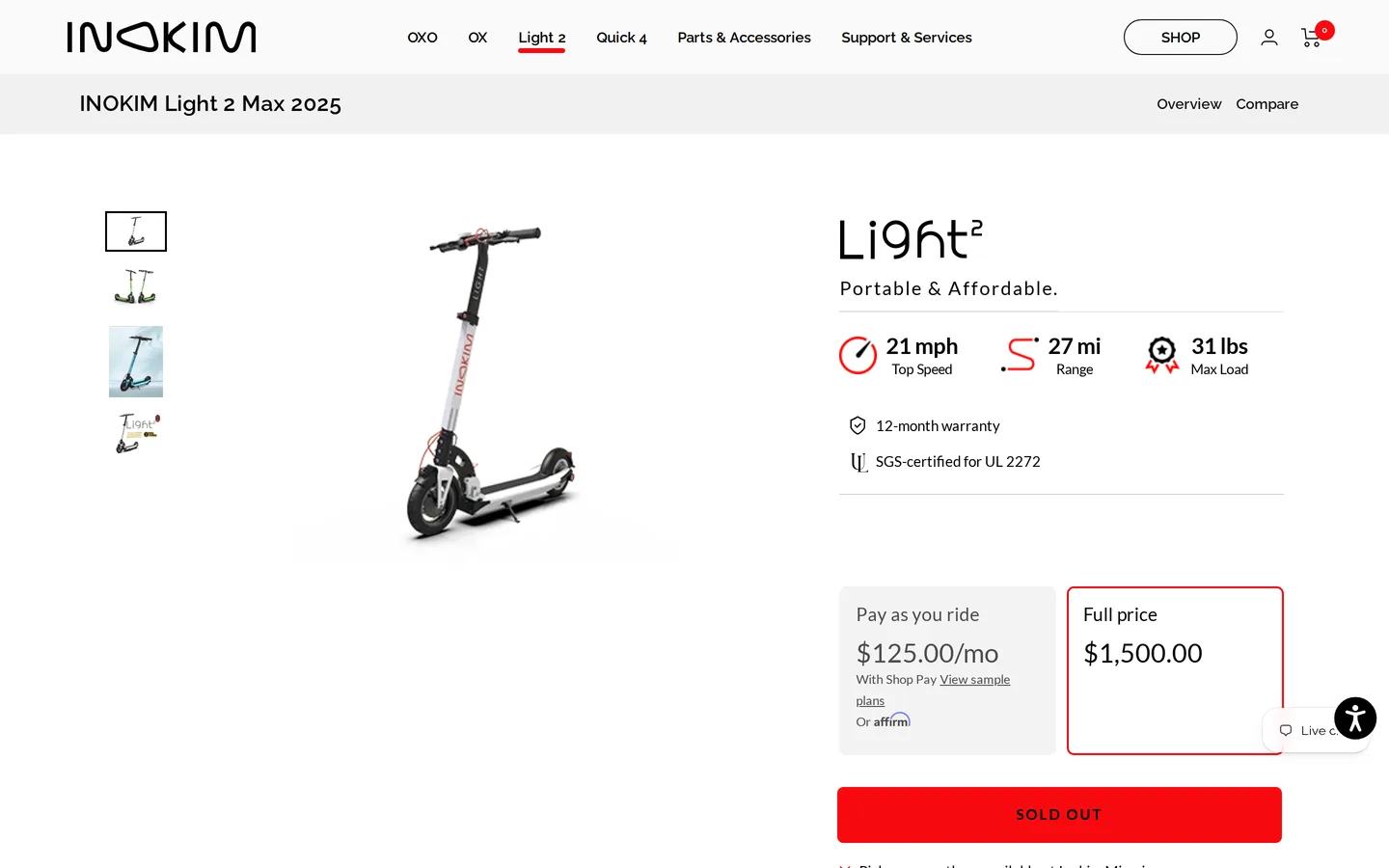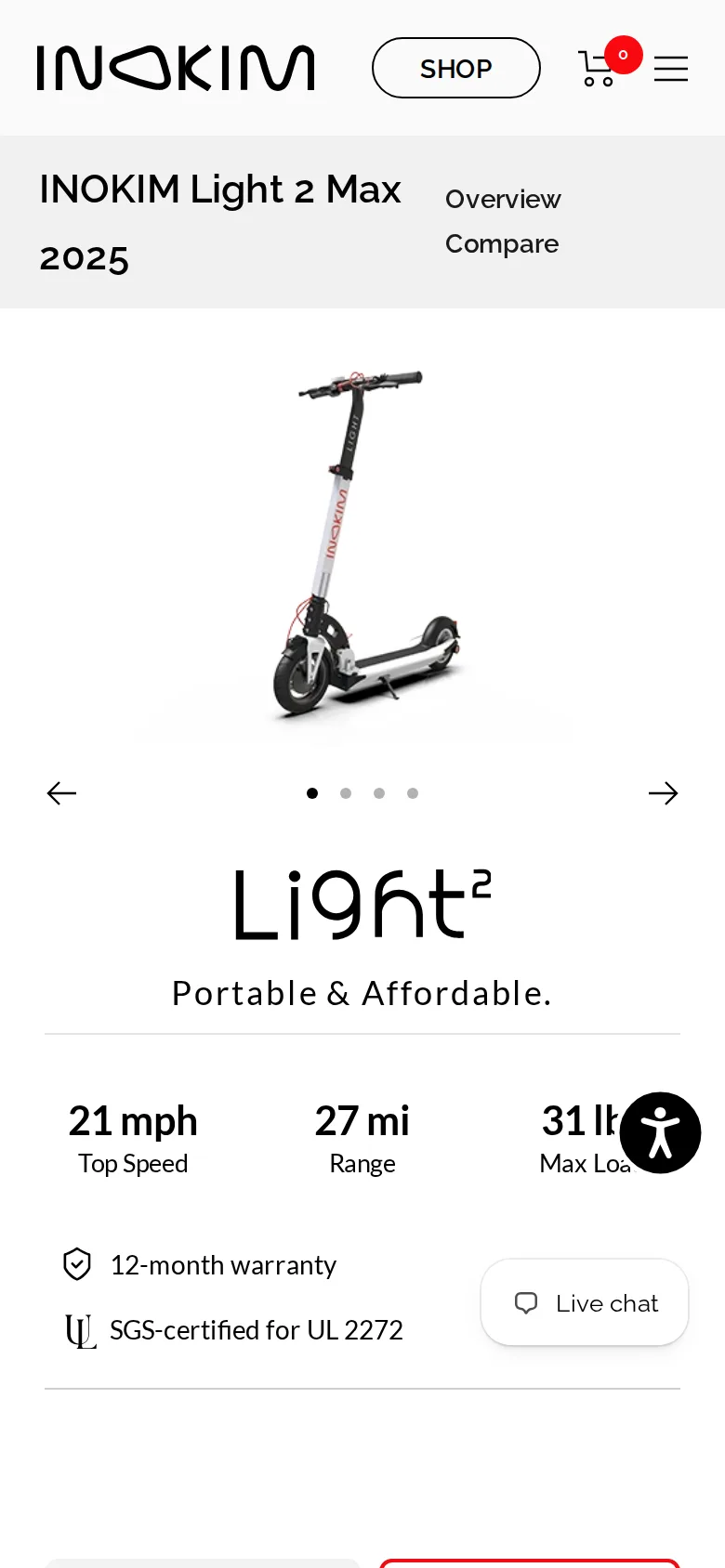
Inokim describes the Light 2 Max in two words: Portable & Affordable — easy to carry, easy to pay for.
The first word is right. The second is up for debate.
One thing that needs clearing up on the spec sheet
On the product page the three headline numbers read: 21 mph top speed, 27 miles of range, and “31 lbs Max Load”.
31 pounds is about 14 kg. No scooter has a maximum load of 14 kg — a five-year-old weighs more than that. This is almost certainly the weight of the scooter itself under the wrong label.
We raise it not to catch a typo, but because this is exactly the sort of thing you have to ask about before paying $1,500. If you weigh 90 kg, the real payload is the deciding specification.
When a spec sheet contains one impossible line, do not guess what the maker meant. Ask directly, and ask for the answer in writing.
Assume 14 kg is the scooter's weight. Then what?
If that is what it means, the Light 2 Max is one of the lightest scooters you can buy — lighter than the Segway F2 II (17.3 kg) and far lighter than the Apollo Go (22 kg), only a little heavier than the NIU KQi Air (11.7 kg).
At 14 kg the scooter sits inside the range where an adult carries it up two flights of stairs without stopping. That threshold is what separates a scooter you take with you from a scooter that lives in the basement.
SGS certification to UL 2272
Like the pricier OXO from the same brand, the Light 2 Max puts SGS certification to UL 2272 right in the headline block at the top of the page.
Inokim is one of the few makers that treats battery safety certification as equal in status to speed and range, across every model in the range. That is a consistent presentation policy and it deserves credit.
$1,500: the comparison you cannot avoid
Side by side, inside this same series:
Gotrax G4, $449: 32 km/h, 40 km, UL 2272, two-year warranty, integrated lock.
Inokim Light 2 Max, $1,500: 34 km/h, 43 km, UL 2272, 12-month warranty.
The specification gap: 2 km/h faster, 3 km further. The price gap: more than three times. The warranty gap: Inokim's is half as long.
So what does the extra $1,050 buy?
The honest answer: weight and build quality. Inokim has a reputation among owners for frame machining, for how tight the folding joint stays, and for how the mechanism survives a few thousand fold cycles. None of that appears on a spec sheet, and all of it decides what the second year of ownership feels like.
If you fold and unfold a scooter four times a day, the tightness of that joint is something you feel every single time. If you fold it twice a week, you are paying for something you do not use.
The folding joint: the part that decides a scooter's lifespan
Since Inokim's sales argument is build quality, it is worth being specific about which part of the scooter benefits.
The answer is the folding joint at the stem. This part takes every load the handlebar passes into the deck, and it has to take it at a point that contains a hinge — a structural weak spot by design.
Folding joints degrade in three stages:
A little play appears when you rock the bars side to side. Harmless at this stage.
The play grows, and you start to hear a knock going over speed bumps.
The play gets big enough that the bars lag behind the front wheel. At this stage the scooter is no longer safe.
How fast a scooter goes through those three stages depends almost entirely on the machining and the material of the locking mechanism. That is where the $1,050 between an Inokim and a mass-market scooter actually sits.
On any scooter, check the joint for play every month: stand it up, trap the front wheel between your feet, and rock the bars. Any lag needs tightening straight away.
The 12-month warranty is a real weakness
At $1,500, a 12-month warranty is shorter than the $449 Gotrax (two years) and the $1,999 Kaabo (18 months).
On a product whose core sales argument is durability, a short warranty is a contradiction that is hard to explain away.
The verdict
We score it 7.6. A very well-made scooter at a price that only makes sense if light weight and durability are your first priority. If this is your first scooter, start cheaper.
Nhìn tận mắt