At the top of the Cowboy Cruiser product page there is a small line of text: a Markdown version of this page is available, optimised for AI tools.
No other bicycle brand has thought of that. It tells you what kind of company Cowboy considers itself to be.
A bicycle sold as a technology product
Cowboy has no assist-level control. In its place is AdaptivePower — a system that reads gradient, speed and your own pedalling force and decides how much to push.
In practice this works better than you would expect. On a conventional e-bike you pick level 1 to 5 and have to guess which suits the stretch of road ahead. With AdaptivePower you pedal and the bike follows. Going into a climb, the push increases before you have registered that you are climbing.
This is technology done right: it removes a decision from the rider rather than adding a menu.
Design: where Cowboy has no rival in this series
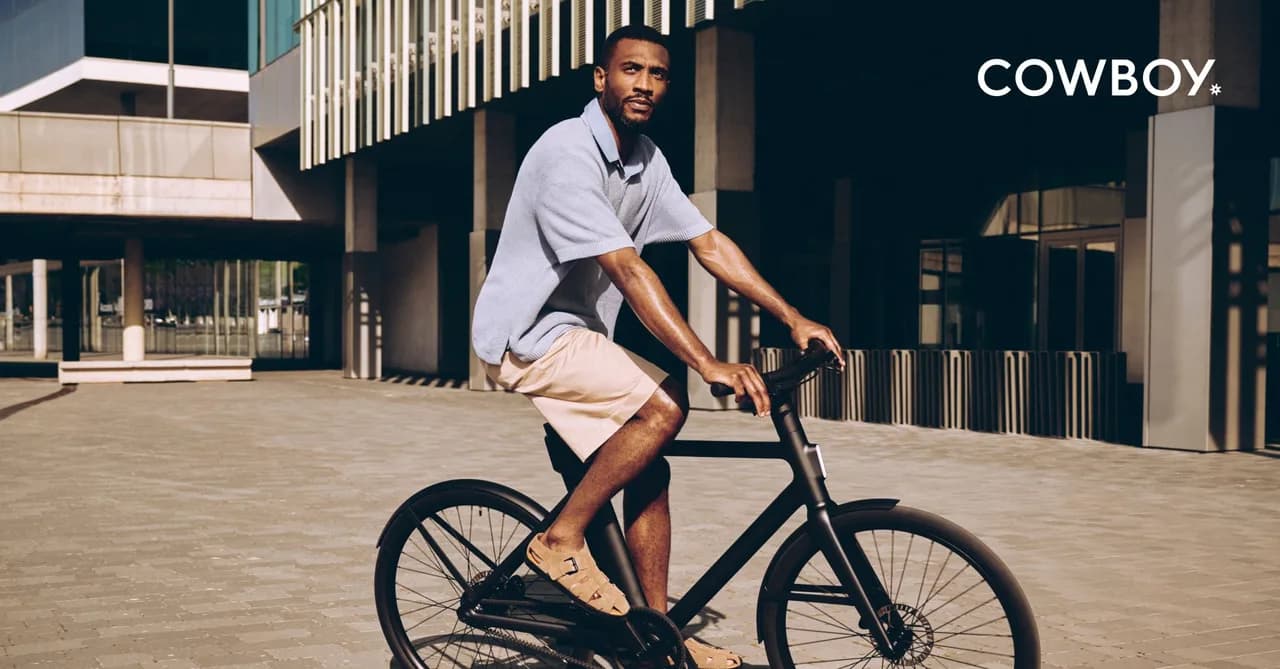
The Cruiser has a raised cockpit and swept bars, giving the upright position of a classic city bike. All electrical and brake cabling is routed inside the frame. No bolted-on display, no external battery pack.

From a distance this does not look like an electric bike. For a lot of buyers, that is exactly what they are paying for: an electric bike that does not look electric.
There are two versions: the Cruiser and the Cruiser ST with a step-through frame. The ST is the easier choice if you wear a skirt or get on and off frequently.
€3,299, and a way around it
The entry price is €3,299 . At that level the Cruiser is about 70% more than an Aventon Level 4, and more than three times the price of a Lectric XP4 in this same series.
Cowboy offers a way around it: a certified refurbished programme starting at €2,399. That is €900 less for the same bike, inspected and recommissioned. On a product whose hardware is durable and whose software is updated continuously, buying refurbished is economically sensible.
No display: a contentious decision
Cowboy fits no display to the handlebar. Instead your phone drops into a wireless charging mount on the stem and becomes the display.
The argument for: a phone has a better screen, better maps, and is always up to date. A fixed monochrome LCD is obsolete in three years, whereas you replace a phone every few years anyway.
The argument against, which also holds: if you do not mount your phone, you do not know your state of charge, your speed, or the current assistance level. On a bike with no assist control that matters less than it would elsewhere — but the charge level still matters.
In rain it becomes a real problem: very few people want to leave their own phone out in the weather on a mount.
This is the kind of design decision that splits users down the middle. If you already mount your phone for navigation, the missing display costs you nothing. If you do not, you will feel its absence.
Refurbished: Cowboy's most sensible option
The certified refurbished programme, selling from €2,399 instead of €3,299, deserves closer attention than a discount line usually gets.
On a product whose value sits mostly in software and design — neither of which wears out — buying used and recommissioned is a sound economic decision.
Three questions to ask before buying any refurbished e-bike, from any brand:
Is the battery new, or an inspected used pack? If used, what percentage of capacity remains?
How long is the warranty on a refurbished bike, and does it differ from the new-bike warranty?
Which parts were replaced during the refurbishment?
The first matters most. A refurbished bike with a pack that has lost 20% of its capacity is a completely different proposition in value terms from one with a new pack.
The risk in a connected bike
Cowboy binds the bike tightly to its app and cloud services: unlocking, location, diagnostics, software updates.
That raises a question a mechanical bicycle never poses:
If this company stops trading in four years, does the bike still ride, and does it still unlock?
Cowboy has been through a difficult financial period, and the European e-bike industry has watched large names disappear. This is not a prediction about Cowboy — it is the kind of risk that should be priced into any product that depends on a manufacturer's servers.
We score it 7.5. An outstanding bike on design and software, pulled down by the price and by how much it depends on a single company.
Nhìn tận mắt