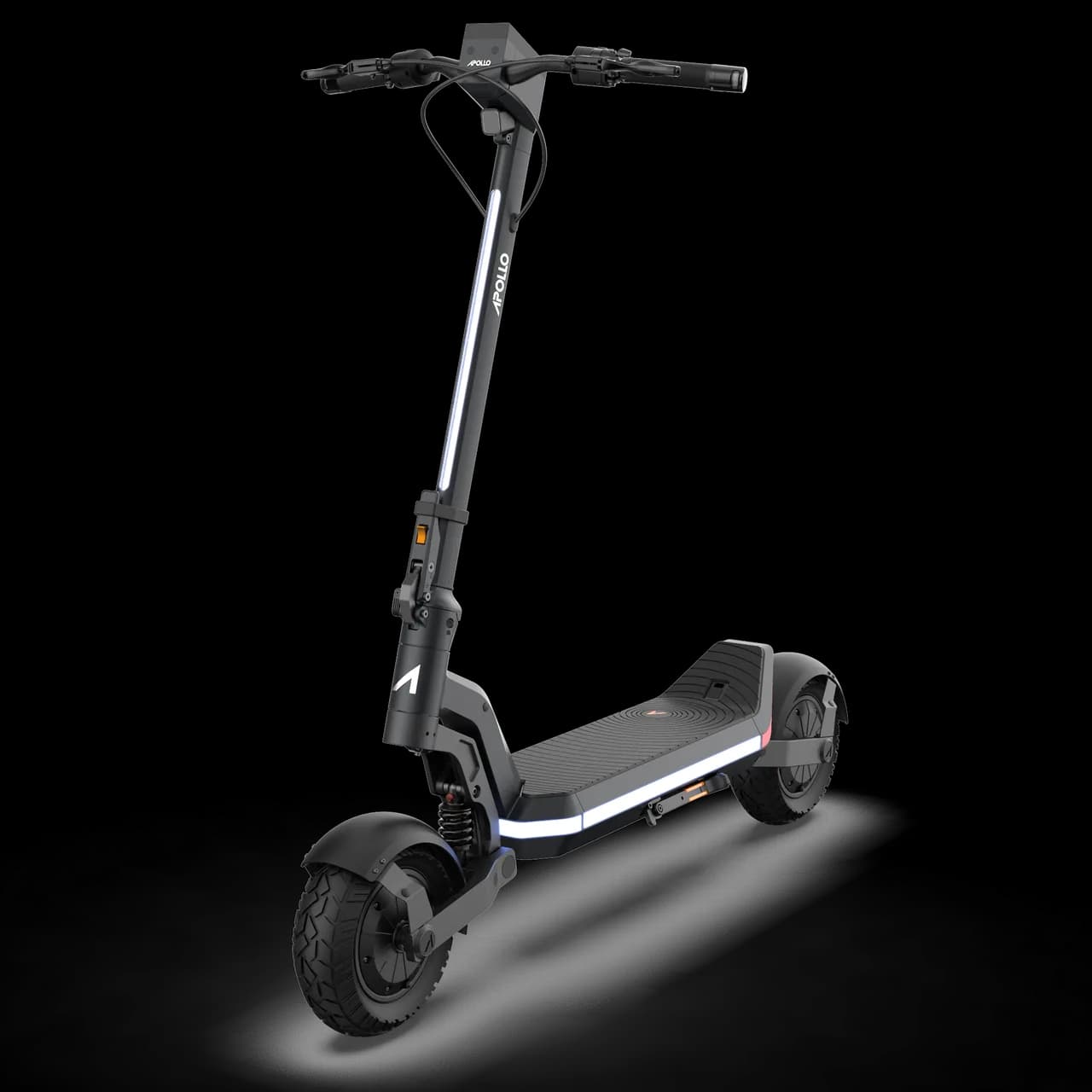
Before the machine, one number: the Phantom 2.0's wheels are about 25 cm across. The front wheel of a 125 cc commuter scooter is around 43 cm.
The Phantom 2.0 reaches 71 km/h. Keep those two facts next to each other for the rest of this review.
The specification
Top speed of 44 mph, about 71 km/h. Range of 50 miles, about 80 km. Dual-motor drive. A 52 Velectrical system. List price $2,199.
The 52 V figure deserves attention. Most commuting scooters run 36 V or 48 V systems. A higher voltage means that for the same power, current is lower — less heat in the wiring, better efficiency, and less voltage sag under acceleration.
80 km is the longest range of any scooter in this series, including the commuting models. That is unusual: fast machines normally travel less far.
The physics of 71 km/h on small wheels
Three things change once a scooter passes roughly 50 km/h.

Stopping distance. Kinetic energy rises with the square of speed. At 71 km/h the stopping distance is roughly four times what it is at 35 km/h.
A pothole becomes a crash. At low speed a 25 cm wheel bounces over a crack. At 71 km/h a medium pothole can stop the front wheel while the rest of you carries on.
Standing up, nothing holds you in place. A motorcyclist sits down, with a seat and a tank to grip between the knees. A scooter rider stands upright, connected only through the handlebars.
There is nothing wrong with riding a 71 km/h scooter. But at that speed, wear what a motorcyclist wears: a full-face helmet, arm and leg armour, gloves.
We are not telling you to avoid this machine. We are telling you not to buy it without buying the protective gear at the same time.
The legal question
In most of the world the legal limit for a standing electric scooter on public roads falls between 20 and 32 km/h. 71 km/h is far beyond it.
Some jurisdictions are still writing their rules for this class of vehicle. That does not mean anything goes — it means you need to check the current rules where you ride, and to understand that a 71 km/h machine in traffic is the rider's responsibility and not only the law's.
The sensible use for this machine in most circumstances: private land, an industrial estate, or a route whose surface you know well.
52 volts: why voltage matters more than you think
The 52 V specification is easy to skim past because it is not the biggest number on the page. But it explains why this machine covers 80 km when other fast scooters manage less.
Power equals voltage times current. For a given power you can use high voltage and low current, or low voltage and high current.
High current causes three problems, all of them losses:
The wiring heats up. That heat is energy lost, and it moves you nowhere.
The controller has to handle more current, so it runs hotter and has to be larger.
Voltage sag under acceleration is more pronounced, which makes the throttle feel choppy.
At 52 V instead of 48 V or 36 V, Apollo lowers the current for the same power. The result is less heat loss, more range, and a smoother throttle when you open it fully.
This is the kind of engineering decision you never see on the road but which shows up in every other number on the spec sheet.
How Apollo sells
The Phantom 2.0 product page shows more than 120 reviews from buyers right under the product name, and the home page asks you to pick a country on arrival — Apollo sells directly only in the US, Canada and Australia.
Both are signs of a company doing this seriously. Publishing reviews means accepting the bad ones too. Limiting the markets it sells in means selling only where it can support the product.
For a buyer outside those three countries, the second half means: the machine arrives as a grey import, and every parts or warranty problem is yours.
The verdict
We score it 8.1. The machine does what it was designed to do very well. The score is not higher because for $2,199 you can buy an electric motorbike that travels 200 km, with motorcycle brakes, motorcycle wheels, and a plate that makes it legal everywhere.
The Phantom 2.0 is a superb toy. It is not the best commuting vehicle for that money.
Nhìn tận mắt