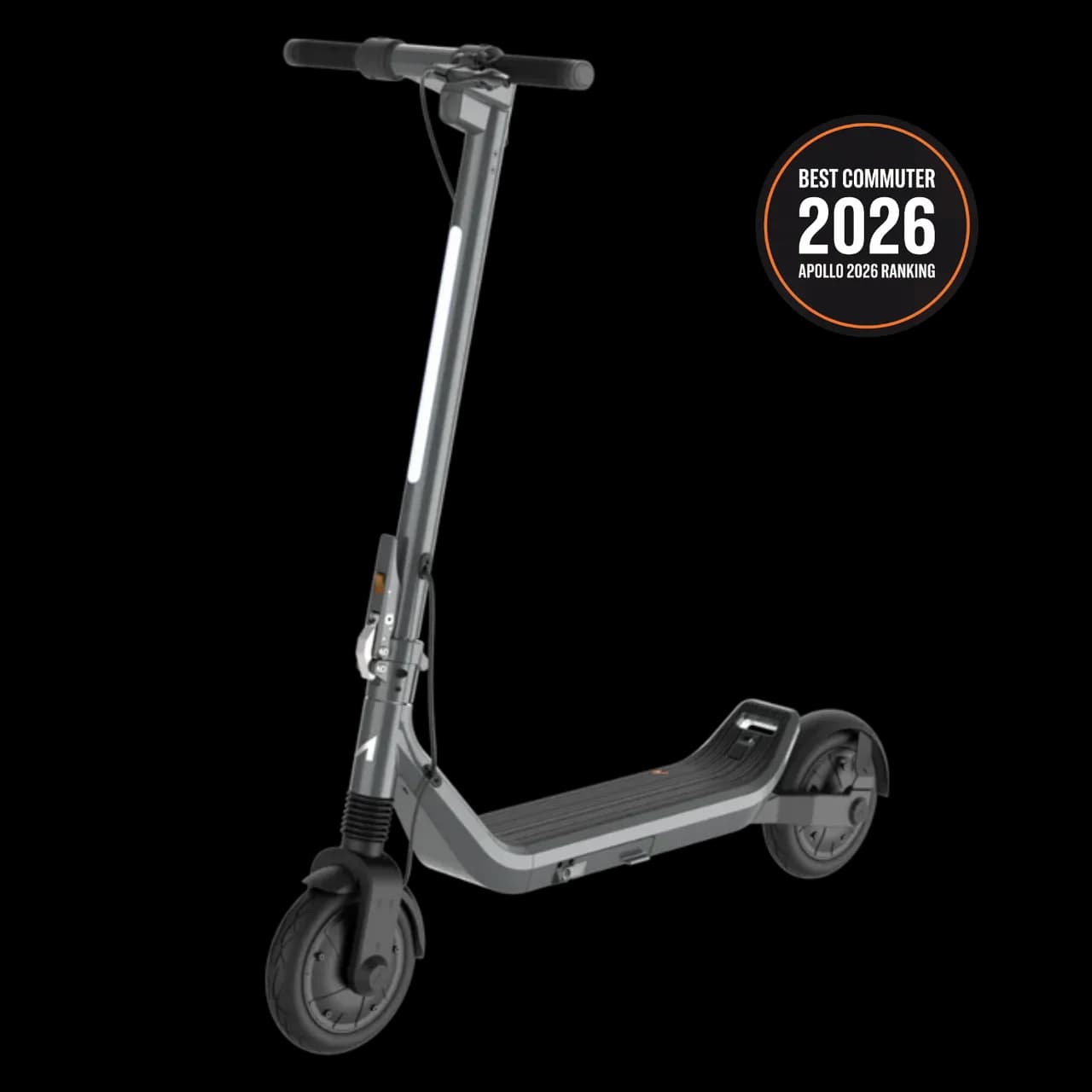
Apollo files the Go under “commuter”. But its spec sheet reads like a performance scooter with the throttle turned down.
Twin motors on a commuting scooter
The Apollo Go uses two-wheel drive — one motor in each wheel, instead of a single rear motor as on almost every scooter at this price.
That brings three things:
Considerably better climbing. Splitting tractive effort across two wheels means less slip at the bottom of a hill.
Better grip on wet surfaces, because both wheels are driving.
Faster acceleration from a standstill.
The price paid: two motors draw more current, and they are heavy. That is part of why this machine weighs 22 kg.
Airflow suspension
Apollo calls its suspension system Airflow — compressed air instead of steel springs.

The advantage of air: a progressive damping curve. Small bumps are absorbed gently, big ones meet much more resistance. A steel spring is linear — the same rate for every impact.
In practice that means the machine does not bounce on lightly rippled tarmac, but still does not bottom out when you drop off a kerb.
Together with the twin motors, this is the most serious chassis in the commuting group of this series.
22 kg, and why that number decides everything
49 pounds, about 22 kg. For comparison within this series: NIU KQi Air 11.7 kg, Segway F2 II 17.3 kg.
The Apollo Go is nearly double the NIU. At this weight you do not carry it up the stairs at a station, you do not lift it comfortably into a car boot, and taking it up to a third-floor flat is something you think about first.
A scooter under 13 kg is something you carry. A scooter over 20 kg is something you ride. They are two different products sharing one name.
If your route runs from your door to the office door with no stairs in between, 22 kg is not a problem and you get the full benefit of twin motors and air suspension.
58 km on twin motors: a number worth noting
There is an apparent paradox in the Apollo Go: it has two motors — drawing more current — and still claims 58 km, close to the single-motor NIU KQi 300's 60 km.
The explanation sits in two places. First, a bigger pack, which is part of why the machine weighs 22 kg. Second, and more subtle: two motors share the work, so each runs at a lower load, closer to its efficiency sweet spot.
One motor working at 90% of its capacity is less efficient than two motors each working at 45%. This is why twin-motor systems do not consume double the energy that intuition suggests.
The condition: the 58 km figure was almost certainly measured in single-motor mode or at low speed. Riding on both motors at 45 km/h, plan for about half.
45 km/h and the legal question
Top speed of 28 mph, about 45 km/h. At that speed a standing scooter — where you balance on a narrow deck over 25 cm wheels — demands real concentration.
In most places, 45 km/h is far above what is permitted for a scooter on a cycle path. Some jurisdictions are still writing rules for this class of vehicle, so check the current regulations where you ride before you buy and before you go out.
On safety: if you buy this one, buy a proper motorcycle-grade helmet rather than a thin cycling shell. The impact energy at 45 km/h is no different from a motorbike's.
Where to buy it
Apollo's site opens a dialogue asking you to choose a country, and states clearly that it sells directly only in the US, Canada and Australia. Everywhere else is a grey import.
Worth credit: Apollo publishes more than 240 customer reviews right on the product page. That is the kind of transparency to look for — and it is rare.
We score it 8.2.
Nhìn tận mắt